
Make room · Step 2
Can your employer own your side business idea?
It can, depending on your paperwork. Check four clauses (moonlighting, IP, non-compete and non-solicit) and whether you've used your employer's time, equipment or confidential information, then take anything unclear to an employment lawyer.
Published November 26, 2026 · Updated November 27, 2026
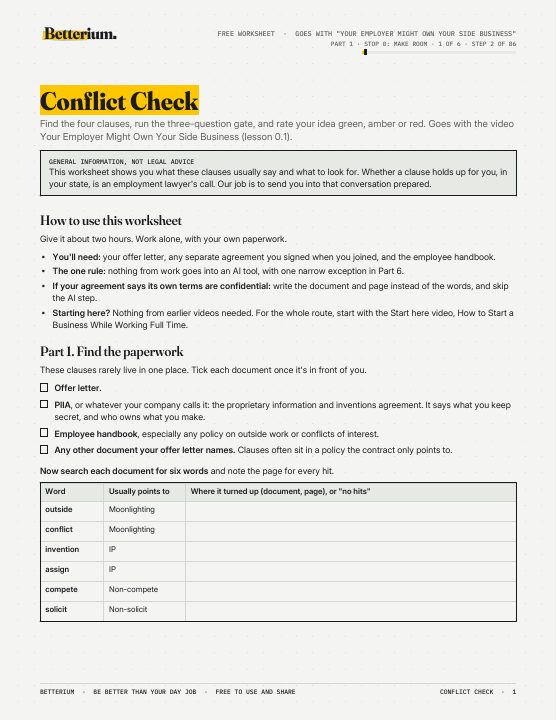
Get the Conflict Check
A green, amber or red rating for your idea, each clause in plain English, your state's current rules, and the questions to take to a lawyer
In short
- Four clauses matter: moonlighting, IP, non-compete and non-solicit.
- Three gate questions about your employer's time, equipment and confidential information turn into a green, amber or red rating.
- Amber and red go to an employment lawyer, with your questions already written.
We're not lawyers, and this is education, not legal advice. Whether a clause holds up for you, in your state, is an employment lawyer's call.
Where do the clauses hide?
Rarely in one place. Check your offer letter, then any PIIA (proprietary information and inventions agreement), then the employee handbook, especially any policy on outside work or conflicts of interest.
Search each document for six words: outside, conflict, invention, assign, compete and solicit. Note the page for every hit.
What do the four clauses say?
Moonlighting says whether you can work on the side at all. The strictest version bans outside paid work. The middle one allows it with approval or disclosure. The loosest allows anything that doesn't compete or create a conflict.
IP says who owns what you make. Watch for "whether or not during working hours" and "related to the company's business." California's Labor Code, section 2870, says your employer can't claim an invention you built entirely on your own time, as long as you didn't use their equipment, supplies, facilities, or trade secrets.1 Those limits don't cover inventions that relate to the employer's business, which is where side ideas built on job knowledge tend to land.
Non-compete limits working against your employer. In 2024, the Federal Trade Commission announced a rule banning most of them. When we checked in November 2026, the FTC's own page said that rule is not in effect and not enforceable.2 So it comes down to state law, and the states differ.
Non-solicit limits going after the employer's clients and people. Check who it covers, because your easiest first clients are often people you met through work.
How do you rate your idea?
Answer three yes-or-no questions. Have you used, or will you use, your employer's time? Their equipment, including the laptop and the company's AI tools? Their confidential information? Any yes turns your rating red until you fix it.
- Green: all four clauses checked, three noes, and nothing reaches your idea. Not a legal all-clear.
- Amber: something is unclear. Pause building, and don't tell anyone about the idea, until a lawyer has answered your questions.
- Red: a gate answer is yes, or a clause plainly covers what you plan. Red stops that idea, not your side business.
Dana, our example, comes out amber.3 Her handbook wants outside work in her industry disclosed, and her PIIA covers anything "related to the Company's business." So she writes one question per circled clause, with the clause quoted underneath.
Can AI help you read the contract?
Carefully. Paste only the clause text, with your employer's name swapped for "Employer." Skip this if the agreement says its terms are confidential. Ask for each clause quoted word for word, explained in plain English, and no opinion on enforceability.
Then check every quote against your original. A 2024 Stanford study found that even AI research tools built for lawyers got things wrong more than one in six times.4 The rating stays yours. Save it in your Venture File as "Conflict Check."
Try it this week
Check your contract's moonlighting, IP, non-compete and non-solicit clauses and rate your idea. Give it about two hours. The free Conflict Check worksheet walks you through it, with space for your lawyer questions.
Put this lesson to work with the Conflict Check
Questions people ask
Does working on my own laptop make the idea mine?
It helps, but it may not settle things if the idea sits inside your employer's business. That's a question for an employment lawyer.
What if I can't find the clauses?
List every document your offer letter names and search each one. If it's still unclear, rate it amber and take your questions to a lawyer. How to Find a Business Mentor for Free (coming soon) helps you find one.
What if my rating is red?
Stop that idea, not the route. Go back to Stop Looking for a Business Idea (coming soon) and pick a problem outside your employer's world.
← Previous step: How to start a business while working full time
- California Labor Code section 2870, full text as quoted in Venture Corporation v. Barrett, No. 5:13-cv-03384-PSG (N.D. Cal., order of 9 Dec 2015), US Courts via GovInfo. ↩
- Federal Trade Commission, "Noncompete Rule" page: "The Noncompete Rule is not in effect and it is not enforceable." Federal Trade Commission, "Federal Trade Commission Files to Accede to Vacatur of Non-Compete Clause Rule", press release, 5 Sep 2025. Federal Register notice listing, removal of the Non-Compete Rule to conform to federal court decisions, 12 Feb 2026. ↩
- Dana is our example, not a real person. ↩
- Stanford HAI, "AI on Trial: Legal Models Hallucinate in 1 out of 6 (or More) Benchmarking Queries", May 2024 (Stanford RegLab and HAI preprint). Incorrect or misgrounded answers more than 17% of the time for Lexis+ AI and Ask Practical Law AI, and more than 34% for Westlaw AI-Assisted Research. Legal research questions, not contract reading. ↩